

#thedeadpoetssociety
Elizabeth Barrett Browning (1806–1861) was one of the most celebrated poets of the Victorian era — a writer whose passionate love poetry, fierce social conscience, and pioneering feminist voice shaped English literature and influenced writers from Emily Dickinson to Edgar Allan Poe.


1. Early Life & Formation
- Born 6 March 1806 in County Durham, the eldest of 12 children.
- Raised at Hope End, her family’s large Herefordshire estate, surrounded by the Malvern Hills — a landscape that nourished her imagination.
- A precocious child: writing poetry by age 11, devouring classical literature, and immersing herself in books whenever she could escape the social rituals of country‑house life.

Illness & lifelong frailty
- At 15, she suffered a severe illness, likely a spinal injury, leaving her with chronic pain and later lung problems.
- She took laudanum for pain from a young age, contributing to her frailty.
- Periods of invalidism shaped her solitude, introspection, and the intensity of her inner life.


2. Rise to Literary Fame
- Her first major collection, The Seraphim and Other Poems (1838), established her as a serious poet.
- The breakthrough came with Poems (1844) — a two‑volume work that made her internationally famous and drew the admiration of Robert Browning.
- By the 1840s she was considered a rival to Tennyson for the Poet Laureateship.

Themes of her early and mid‑career poetry
- Spiritual longing and metaphysical questioning
- Classical and biblical allusion
- Social justice: she wrote against slavery, child labour, and political oppression.
- Women’s rights and the constraints of Victorian society

Her humane, reformist voice made her one of the most socially engaged poets of her century.


3. The Great Love Story: Elizabeth & Robert Browning

- In January 1845, Robert Browning wrote his famous first letter:
  “I love your verses with all my heart… and I love you too.”
- Their courtship unfolded through hundreds of letters — passionate, intellectual, and secret.
- Elizabeth’s father violently opposed marriage for any of his children.
- They married 12 September 1846, in secret; she left home a week later and was disinherited.
- The couple moved to Italy, where she found renewed health, political inspiration, and creative energy.

Their marriage was one of the great literary partnerships of the 19th century.


4. Major Works & Poetic Achievements

Sonnets from the Portuguese (1850)
Her most famous work — a sequence of 44 love sonnets written during her courtship with Robert.
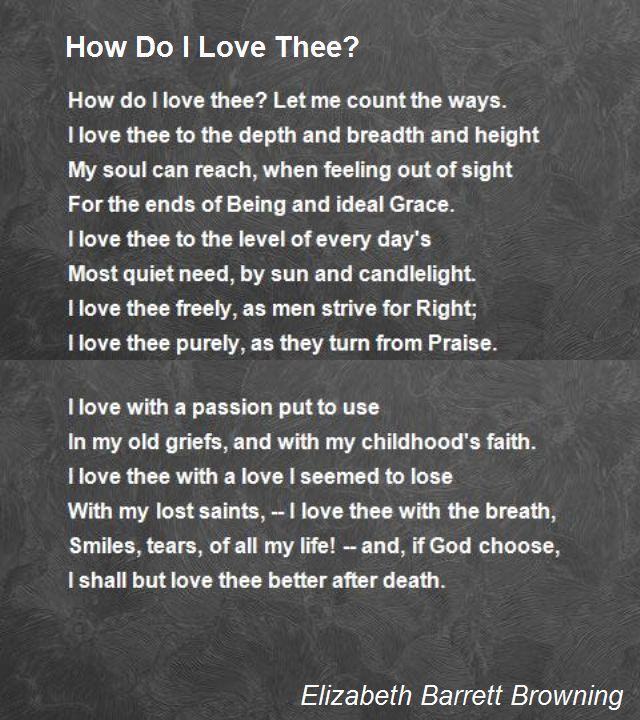
- Includes “How Do I Love Thee?” (Sonnet 43), one of the most beloved love poems in English.
- The title was a private joke: Robert called her “my little Portuguese” because of her dark colouring.

These sonnets trace her journey from fear and self‑doubt to full, radiant love.


Aurora Leigh (1856)
A novel‑in‑verse and an early feminist text.
- Follows a woman determined to become a poet despite social constraints.
- Explores art, gender, class, and the moral responsibilities of the writer.
- Now recognised as one of the most important feminist works of the Victorian era.


Political & Social Poetry
Elizabeth Barrett Browning was a poet of conscience.
She wrote against:
- Slavery (influencing abolitionist thought)
- Child labour in mines and mills
- Italian oppression under Austrian rule
- Restrictions on women in Victorian society

Her poetry was widely read in Britain and America, shaping public opinion.


5. Later Years & Death
- She and Robert had one son, Robert “Pen” Barrett Browning, in 1849.
- She continued to write prolifically in Italy, engaging with the Risorgimento and European politics.
- Died 29 June 1861 in Florence, aged 55.
- Robert published her final poems posthumously.

Her influence endured: Emily Dickinson kept a portrait of her on her wall and called her “that Foreign Lady,” a guiding star.


6. Why She Still Matters
Elizabeth Barrett Browning stands at the crossroads of:
- Romantic lyricism
- Victorian moral urgency
- Early feminist thought
- Political activism
- Intimate, transformative love poetry.

A poet who overcame illness to become one of the most important women from her era.

©✍️CarolynCrossley + CoPilot AI

Sources:
Wikipedia
Poetry Foundation
Britannica


You must be logged in to post a comment.